Choosing the best Lipstick Filling Machine in China is not a simple price comparison. The right machine should match your formula, container size, production volume, and quality targets. A small laboratory may need a compact, heated piston filler. A large factory may require servo control, multiple nozzles, and automated mould handling.
Practical evaluations should begin with the product itself. Ask the supplier to test your lipstick base, pigments, fragrance, and packaging samples. Watch the filling process closely. Does the material flow smoothly? Are air bubbles visible? Is the fill weight consistent across ten or more units? A stainless-steel hopper, stable temperature control, and easy-clean contact parts can reduce contamination risks. These details matter more than attractive photographs.
Reliable Chinese manufacturers should provide technical drawings, operating instructions, maintenance schedules, and traceable component information. They should also explain electrical standards, installation requirements, operator training, and after-sales support. Documentation for material compatibility and quality control is valuable when products enter different markets. Compliance must be checked against the applicable cosmetic, safety, and machinery rules in each destination country.
There is no universal winner. A machine that performs well for a soft satin formula may struggle with a high-pigment matte lipstick. A cheaper model may also create higher downtime later. That is easy to overlook. My assessment would include factory testing, sample inspection, delivery records, and a clear warranty before purchase. Even then, the decision deserves review. Equipment specifications can change, and supplier claims should never replace measured results.
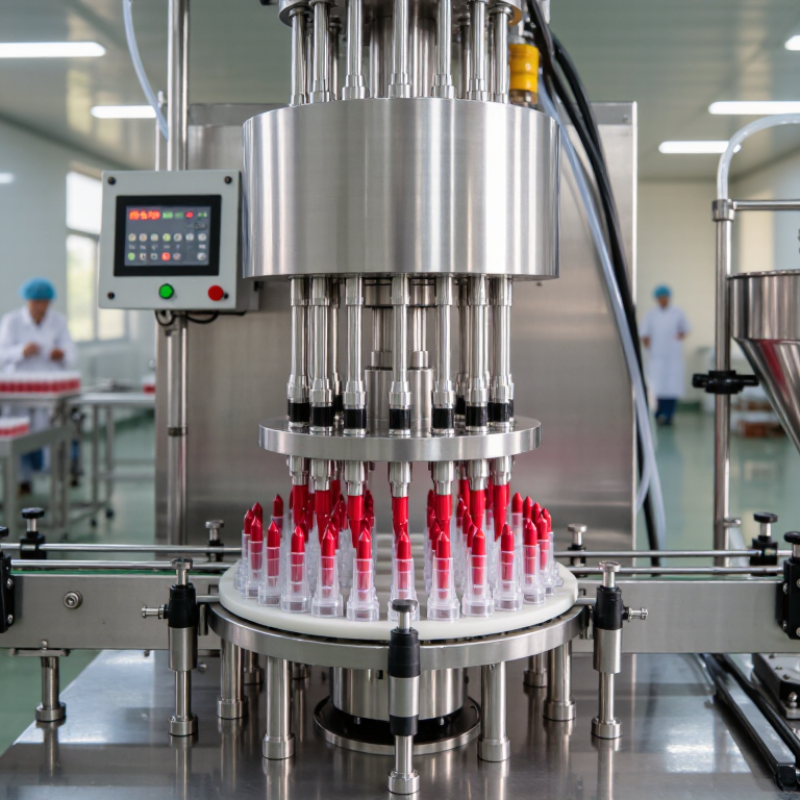
What Is the Best Lipstick Filling Machine in China?
The best lipstick filling machine in China depends on product formula, mold design, and daily output. Piston filling machines suit standard lipstick formulas and steady production. Servo-driven systems offer more precise dosing for different stick sizes. Heated hoppers keep wax-based material fluid during filling. This detail matters when the formula cools quickly. On a production floor, I would inspect temperature stability, nozzle movement, and cleaning access before judging price. A polished exterior proves little.
Lipstick filling machines in China commonly advertise outputs between 20 and 60 pieces per minute. That range is useful, but it needs careful interpretation. A 20-piece rate may include manual mold loading and frequent checks. A 60-piece rate usually requires multiple nozzles, prepared molds, and stable material flow. Small temperature changes can cause dents, air pockets, or uneven tops. These defects waste more time than a slower filling cycle. The stated speed is not always the usable speed.
A reliable evaluation should include a sample test with your actual formula and molds. Measure fill-weight variation across several batches. Check whether the machine maintains temperature during a long run. Ask for electrical drawings, operating instructions, spare-part lists, and operator training. I would also test changeover time, because a fast machine can become inconvenient between colors. My first estimate may be optimistic. Real output often falls after cleaning, inspection, and mold replacement. That gap deserves honest calculation.
| Machine Type | Filling Method | Typical Fill Range | Typical Output | Suitable Filling Temperature | Filling Accuracy | Automation Level | Best Application |
|---|---|---|---|---|---|---|---|
| Semi-Automatic Single-Nozzle Machine | Heated hopper with pneumatic piston or gear pump | 2–15 ml per piece | 20–30 pieces/minute | 70–95°C, depending on formula | Typically ±0.5%–1.0% | Operator loads containers and transfers filled units manually | Small production runs, product testing, seasonal colors, and flexible batch changes |
| Servo Piston Filling Machine Balanced Choice | Servo-driven piston with heated product hopper | 1–20 ml per piece | 30–45 pieces/minute | 65–95°C, based on wax and oil composition | Typically ±0.3%–0.8% | Automatic dosing with manual or semi-automatic container loading | Medium-scale production requiring repeatable fill volume and quick recipe adjustment |
| Multi-Nozzle Linear Machine | Parallel heated filling nozzles with piston or gear-pump dosing | 2–15 ml per piece | 40–60 pieces/minute | 70–100°C, depending on viscosity | Typically ±0.5%–1.0% | Automatic indexing with multiple containers filled in each cycle | Stable medium-volume production with a limited number of lipstick formats |
| Rotary Lipstick Filling Machine | Rotary indexing table with several heated filling stations | 1–15 ml per piece | 45–60 pieces/minute | 70–100°C, depending on formula and mold design | Typically ±0.5%–1.0% | Automatic filling and indexing; cooling and demolding may be integrated | Continuous production where consistent throughput and reduced handling are priorities |
| Vacuum-Assisted Filling Machine | Heated dosing combined with vacuum support to reduce air pockets | 2–12 ml per piece | 20–40 pieces/minute | 70–95°C, according to formula requirements | Typically ±0.5%–1.0% | Semi-automatic or automatic, depending on container loading system | Dense, highly pigmented, or air-sensitive formulas that require improved surface quality |
| Servo Gear-Pump Filling Machine | Temperature-controlled servo gear pump | 1–10 ml per piece | 30–50 pieces/minute | 65–90°C, depending on viscosity and shear sensitivity | Typically ±0.3%–0.8% | Automatic dosing with programmable fill speed and volume | Premium formulas, frequent color changes, and applications needing precise flow control |
Selection guide: For a target of 20–60 pieces per minute, a servo piston machine is usually the most versatile option for medium production, while a multi-nozzle or rotary machine is more suitable for higher and more continuous output. Actual capacity depends on fill volume, lipstick formula viscosity, heating time, mold design, cooling method, container loading, and operator skill.
Piston filling machines suit steady, standard formulas. Heated hoppers keep wax-based material fluid. Servo-driven systems improve dosing for different stick sizes.
Advertised output commonly ranges from 20 to 60 pieces per minute. A 20-piece rate may include manual mold loading. A 60-piece rate usually needs multiple nozzles and prepared molds.
Not always. Cleaning, inspection, mold replacement, and temperature adjustments reduce usable output. Real production can be slower.
Small temperature changes may cause dents, air pockets, or uneven tops. A heated hopper supports steady material flow. Check temperature during a long production run.
Use your actual formula and molds during a sample test. Measure fill-weight variation across several batches. Inspect the tops closely.
Review nozzle movement, heating stability, cleaning access, and changeover time. Request electrical drawings, operating instructions, spare-part lists, and training details. A polished exterior proves little.
Confirm container dimensions, fill volume, temperature range, and cooling layout. Narrow mold necks can cause unexpected filling problems. Written specifications reduce confusion.
Look for installation guidance, operator training, remote diagnostics, and available spare parts. Ask about warranty procedures and technician coverage. Response time matters during a stopped production line.
Automation can include foot-pedal control, mold transfer, and recipe storage. It may reduce labor but increase training and maintenance needs. More automation is not automatically better.
Include filling, mold loading, cleaning, inspection, and changeover time. My first estimate may be too optimistic. A slower machine may deliver steadier usable output.
Choosing the right Lipstick Filling Machine in China requires careful evaluation of production capacity, filling accuracy, temperature control, and supplier support. Available systems can handle different output levels, commonly ranging from 20 to 60 pieces per minute, making them suitable for small, medium, or large-scale cosmetic production. Hot-fill systems typically maintain lipstick temperatures between 70 and 85°C to support smooth material flow, consistent filling, and reliable product formation. Fill volumes from 5 to 30 mL and precise servo control are also important for minimizing variation and reducing material waste.
Buyers should confirm that the equipment supports GMP principles and ISO 22716-related cosmetic manufacturing practices. When comparing Chinese suppliers, consider automation level, customization options, mold compatibility, cleaning procedures, installation training, spare-parts availability, and after-sales service. A well-selected machine should combine stable performance, user-friendly operation, flexible production settings, and dependable technical support to meet both current requirements and future production growth.

 haoruide